Cookie Preferences
By clicking, you agree to store cookies on your device to enhance navigation, analyze usage, and support marketing.
Thank you! Your submission has been received!
Oops! Something went wrong while submitting the form.

.svg)

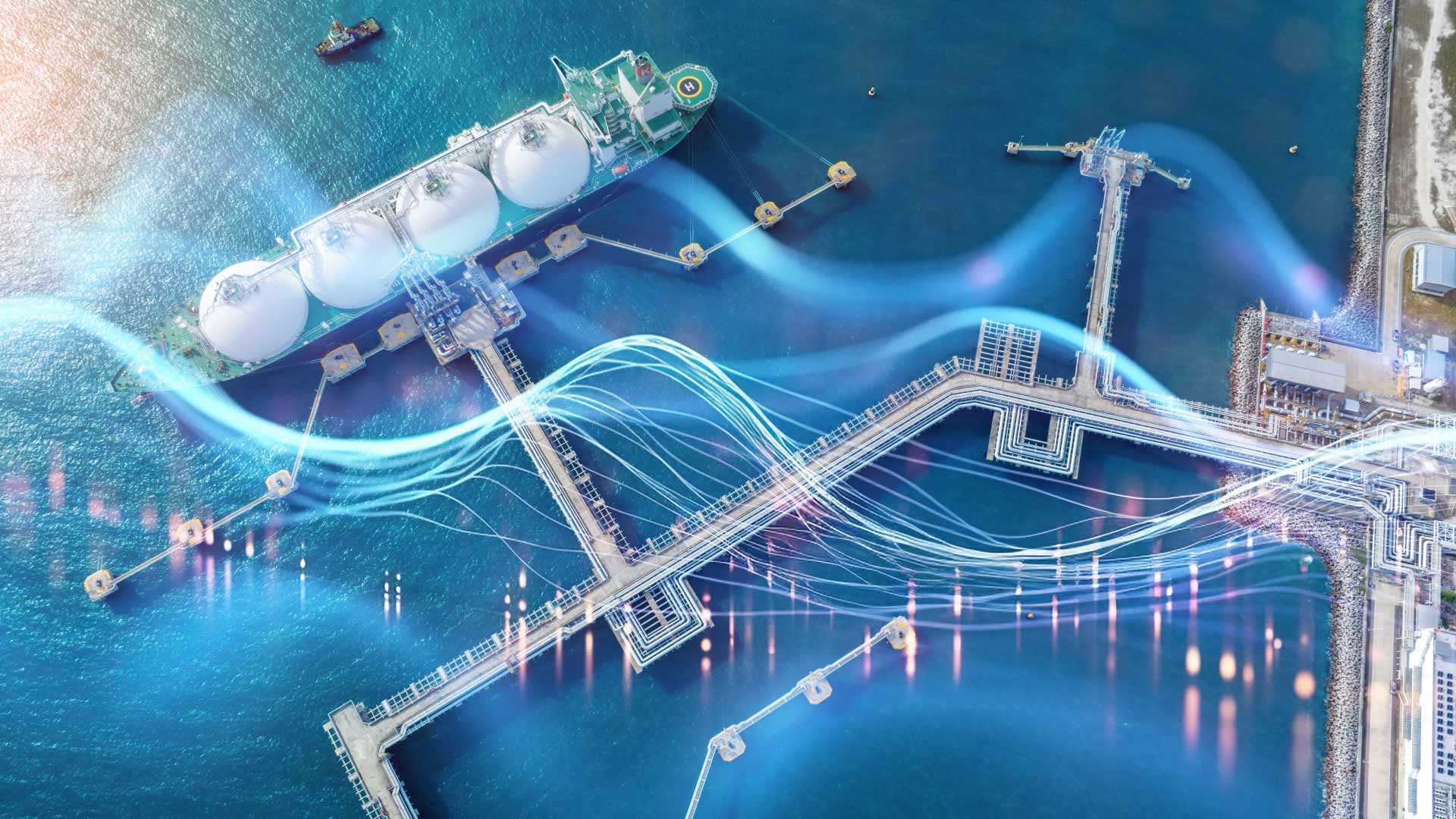
The global LNG market has taken on a new level of strategic importance. It sits at the intersection of energy security, geopolitical tension, and economic resilience. As LNG26 approaches, conversations across the sector are shifting toward a single reality. Geopolitics is no longer a backdrop to LNG. It is one of the dominant forces shaping demand, trade routes, pricing, and investment decisions.
Major LNG operators, including integrated gas businesses from companies like Shell, ExxonMobil, and ConocoPhillips, are preparing for a market that will remain turbulent for the foreseeable future. Trade disputes, disruptions to shipping corridors, shifting alliances, and competing national energy strategies have created a level of volatility that cannot be managed with traditional tools. The sector needs better visibility, faster decision cycles, and more confidence during periods of uncertainty.
This is where artificial intelligence moves from a technology story to a resilience story. AI has a growing presence in the energy landscape, not only because data centers are increasing global energy demand, but also because AI offers industrial operators a practical way to navigate rapid change, operational risk, and supply pressure. LNG is becoming one of the clearest examples of this trend.
The LNG sector has always been global, but the level of geopolitical influence on trade has increased significantly. According to industry analysis, tariff disputes between major economies have rerouted LNG cargoes and reshaped procurement strategies. Buyers are no longer simply hunting for price. They are managing exposure to political risk.
Energy security has climbed to the top of national agendas, especially in Europe where diversification away from Russian pipeline gas has created new long-term demand for LNG imports. At the same time, tensions across the Middle East and instability around key maritime corridors, including the Red Sea, have introduced operational threats to shipping and contributed to price swings. These dynamics highlight a simple truth. LNG markets are now exposed to real time geopolitical events with unprecedented intensity.
The upcoming LNG26 conversation around geopolitics reflects a growing consensus. The market is less predictable than ever, so operators need a new level of agility. They need to anticipate disruption, adapt quickly, and maintain reliable output even when global conditions shift overnight.
Volatility hits the entire LNG value chain. A diplomatic dispute can change a buyer’s source of supply. A shipping route disruption can delay cargoes and affect regasification schedules. A regional conflict can create sudden demand spikes or force production adjustments. Operators are expected to respond fast, maintain safety, protect output, and control costs through all of it.
The traditional decision support systems used across LNG operations were not designed for this level of complexity. They track data, but they do not reason with it. They provide historical trends, but they do not understand context or operational priorities. They can monitor equipment, but they cannot guide technicians or engineers on how to respond to unexpected constraints.
This leaves operators exposed during periods of rapid change. Blind spots grow. Response windows shrink. Decision makers rely on a mix of tribal knowledge, manual analysis, and fragmented information. That is risky in a geopolitical climate where every hour counts.
The sector needs stronger operational intelligence. Not just analytics. Intelligence that can interpret the state of assets, understand operational limits, factor in external pressures, and offer recommendations with real clarity.
AI is gaining attention in LNG because it supports exactly the kind of resilience the sector now requires. It does not remove geopolitical risk. It makes operators more capable of absorbing it.
Hybrid AI, in particular, gives LNG businesses something they have not had before. Real time decision support that combines human knowledge, rules, operational data, and adaptive machine learning into one consistent intelligence layer. AI systems can evaluate sensor inputs, maintenance records, lab data, process limits, and market signals in a single contextual frame. When uncertainty rises, the guidance remains clear.
When geopolitical events disrupt supply chains, AI can generate scenario models to support dispatch planning and operational adjustments. When production assets experience stress during demand surges, AI can identify early signs of performance deterioration and recommend interventions. When schedules tighten, AI can highlight the safest path to maintain output without exceeding operational limits.
This is where AI becomes part of the energy security discussion. It protects uptime. It provides foresight. It reduces the probability of failure during high-risk periods. It transforms complex environments into manageable ones.
The LNG sector benefits from AI at multiple levels.
1. Production and Liquefaction
Plants operate under tighter constraints during volatile periods. AI can support control room teams with contextual recommendations that improve stability and efficiency.
2. Predictive Maintenance
Unplanned downtime becomes far more damaging when global supply is unstable. AI-driven predictive maintenance reduces these risks by identifying issues before they escalate.
3. Shipping and Routing
AI optimizes routing decisions when maritime security risks or weather disruptions affect shipping lanes. It offers operators a real time view of constraints and alternatives.
4. Market Forecasting
AI improves forecasting by incorporating geopolitical signals, weather patterns, storage trends, and global demand indicators into dynamic predictive models.
5. Workforce Knowledge Retention
As the LNG workforce ages, critical operational knowledge becomes harder to preserve. AI systems can capture expert reasoning and keep it active within operational workflows.
This combination of operational intelligence and foresight creates a strategic advantage that traditional systems cannot match. In a world where geopolitics drives volatility, intelligence drives resilience.
The geopolitical discussions at LNG26 are expected to focus on trade relations, diversification strategies, and global supply security. Companies participating in the event have already signaled that resilience, agility, and operational readiness are now core components of LNG competitiveness.
AI sits at the heart of this shift. As the research highlights, AI is not only transforming how energy is generated and consumed. It is becoming essential for how energy systems operate under pressure.
Operators who embrace AI will gain an advantage in stability, safety, and financial performance. Those who wait will find themselves reacting to market conditions that no longer reward slow decision cycles or limited visibility.
The future of LNG will not be shaped by geopolitics alone. It will be shaped by how operators use intelligence to navigate geopolitics with confidence.
The LNG industry is entering an era defined by uncertainty. Geopolitical dynamics are influencing every aspect of the market, from long-term contracts to daily cargo movements. Energy security is no longer a regional concern. It is global. It is interconnected. And it is highly sensitive to shifts in policy, conflict, economics, and supply.
AI gives LNG operators the capability to perform in this environment. It strengthens operational reliability. It enhances decision making. It increases clarity during volatile conditions. It preserves the expertise needed to run complex facilities. Most importantly, it gives operators a way to move from reaction to readiness.
As LNG26 approaches, one trend is clear. The future of LNG belongs to those who combine experience with intelligence. The companies investing in advanced decision support will be the ones best prepared for whatever the geopolitical landscape delivers next.
Join us at LNG2026 to explore what this future looks like in practice. Visit Beyond Limits at Stand 8105 and learn how AI driven operational intelligence is shaping the next chapter of global energy security.
https://www.beyond.ai/events/beyond-limits-at-lng2026